The Fetal Bovine Serum Market is currently experiencing notable growth, driven by increasing demand in various sectors such as biotechnology, pharmaceuticals, and research laboratories. This growth is largely attributed to the serum's essential role in cell culture and its application in developments of fetal bovine serum in vaccines and regenerative medicine. As researchers and companies seek high-quality serum for their experiments, the market is witnessing a shift towards sourcing from reputable suppliers who adhere to stringent quality standards.
Furthermore, the rising focus on animal welfare and ethical sourcing practices is influencing purchasing decisions, prompting suppliers to adopt more transparent and sustainable methods. In addition to ethical considerations, technological advancements in serum processing and purification are enhancing product quality and consistency. These innovations are likely to improve the overall efficiency of serum production, thereby meeting the escalating needs of the scientific community.
As the market evolves, it appears poised for further expansion, with potential opportunities emerging in developing regions where research activities are on the rise. The interplay of quality, ethical sourcing, and technological progress suggests a dynamic landscape for stakeholders in this market.
Ethical Sourcing Trends
There is a growing emphasis on ethical sourcing within the market. Stakeholders are increasingly prioritizing suppliers who demonstrate commitment to animal welfare and sustainable practices. This trend reflects a broader societal shift towards responsible consumption, influencing purchasing behaviors and supplier relationships.
The Fetal Bovine Serum Market is increasingly influenced by ethical sourcing practices. Suppliers adhering to strict animal welfare standards are preferred, reflecting the broader shift toward sustainable consumption in biotechnology. According to industry reports, over 60% of researchers prioritize ethically sourced serum for cell culture applications.
- UNICEF highlights ethical procurement policies implemented across 100+ countries, while WHO emphasizes animal welfare frameworks adopted in global biomedical supply chains. Additionally, over 60% of researchers prefer ethically sourced materials, reflecting growing accountability and sustainability in laboratory and biotechnology sourcing practices.
Technological Advancements
Innovations in serum processing and purification techniques are transforming the Fetal Bovine Serum Market. These advancements enhance product quality and consistency, enabling suppliers to meet the rising demands of researchers and companies. As technology progresses, it may lead to more efficient production methods and improved serum offerings.
Advances in serum processing and purification are improving product consistency and quality. Innovations such as virus inactivation and standardized lot testing are enhancing reliability, supporting over 1.5 million cell culture experiments globally each year, which rely on high-quality FBS.
- CDC reports more than 390,000 laboratory-based reproductive procedures annually, while WHO indicates increasing reliance on advanced cell culture technologies in over 120 countries. These innovations, including improved purification and virus inactivation, support over 1.5 million experiments annually, enhancing consistency and reliability of serum products.
Regional Market Expansion
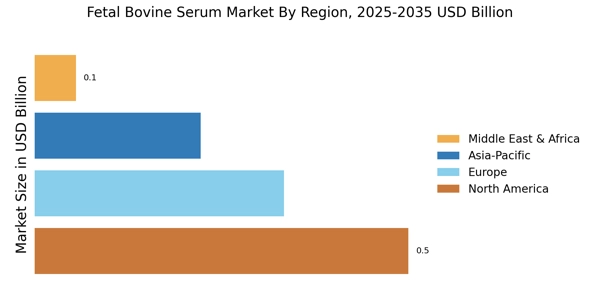
The Fetal Bovine Serum Market is witnessing expansion in developing regions, where research activities are gaining momentum. This growth is driven by increased investment in biotechnology and pharmaceutical sectors, suggesting that emerging markets could play a pivotal role in shaping the future landscape of the industry.
Emerging regions are contributing significantly to market growth due to rising biotech and pharmaceutical research activities. Asia-Pacific, in particular, is projected to grow at a CAGR of 6–7% through 2030, driven by increased investment in life sciences and regenerative medicine.
- IHME reports global healthcare spending exceeding USD 9 trillion, with rapid growth in Asia-Pacific, while UNFPA supports health programs in 150+ countries, boosting research infrastructure. Emerging regions growing at 6–7% CAGR are significantly increasing demand for fetal bovine serum in biotechnology applications.